Where humans win: what AI still can't do (and why it matters)
A pragmatic look at the strengths of human judgment, empathy, and taste in an AI-native world.

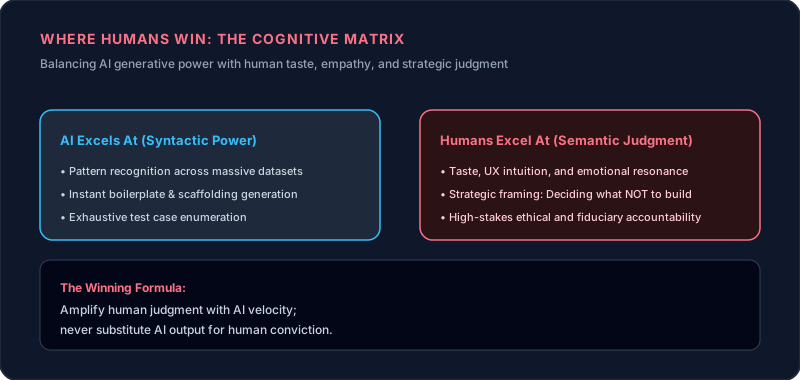
Syntactic Generation vs Semantic Conviction
Large language models excel at synthesizing patterns across existing training distributions. They can write fluent prose, generate boilerplate CRUD routes, and mimic artistic styles in seconds.
What they cannot do is hold skin in the game. They do not feel the customer's frustration when an enterprise billing run fails at midnight. They do not possess the taste to know when a feature should be ruthlessly deleted instead of built. The human role is no longer typing characters—it is defining taste, setting boundaries, and bearing accountability.
Code generation is a solved statistical problem. Knowing what NOT to build, and owning the consequences when things fail, remains an exclusively human discipline.
Taste and Empathy as the Ultimate Engineering Moats
As code generation becomes commoditized, technical leverage concentrates in product taste, system architecture, and deep empathy for end users. The engineers who thrive will not be those who type fastest, but those who ask the deepest questions.
Taste is the ability to recognize that although a model generated 300 lines of functional UI code, the user experience is noisy, cluttered, and unnecessary. Removing complexity requires courage and conviction that cannot be automated.
The Human Oversight Escalation Matrix
In mission-critical production environments, autonomous agents must never have unilateral authority over irreversible decisions. We define a four-quadrant escalation matrix that routes decisions based on financial reversibility and business impact.
// Human oversight escalation decision matrix
export type ActionRiskLevel = "LOW_REVERSIBLE" | "MEDIUM_CORRECTABLE" | "HIGH_IRREVERSIBLE" | "CRITICAL_SYSTEMIC";

export function determineOversightPolicy(actionRisk: ActionRiskLevel): {
  autonomousExecution: boolean;
  requiresHumanSignOff: boolean;
  auditTrailTier: "MINIMAL" | "STANDARD" | "COMPREHENSIVE_FORENSIC";
} {
  switch (actionRisk) {
    case "LOW_REVERSIBLE":
      return { autonomousExecution: true, requiresHumanSignOff: false, auditTrailTier: "MINIMAL" };
    case "MEDIUM_CORRECTABLE":
      return { autonomousExecution: true, requiresHumanSignOff: false, auditTrailTier: "STANDARD" };
    case "HIGH_IRREVERSIBLE":
      return { autonomousExecution: false, requiresHumanSignOff: true, auditTrailTier: "COMPREHENSIVE_FORENSIC" };
    case "CRITICAL_SYSTEMIC":
      return { autonomousExecution: false, requiresHumanSignOff: true, auditTrailTier: "COMPREHENSIVE_FORENSIC" };
  }
}
Navigating High-Stakes Ambiguity and Non-Linear Strategy
Models make decisions by interpolating historical training correlations. When an industry undergoes a paradigm shift or when an enterprise enters a brand-new market, historical distribution curves offer zero predictive guidance.
Strategic pivots require human founders and engineering leaders to make bold leaps of intuition grounded in first-principles reasoning rather than token probabilities.
The Engineering Leader as Curator and Ethical Anchor
The greatest engineering teams of the next decade will not be those with the largest compute clusters, but those with the clearest principles. As leaders, our primary mission is curating high-trust environments where human judgment, ethical boundaries, and craftsmanship guide every autonomous workflow.

Rohit Anand
Engineering Leader & Builder building enterprise platforms, Voice AI, and Agentic systems. Dedicated to evolutionary architecture, team judgment, and delivery excellence.