Engineering case study
Building an Enterprise Voice AI Platform for 24×7 Customer Engagement
As Engineering Director, I lead Birdeye’s enterprise Voice AI platform to transform customer operations: automate repetitive conversations, increase 24×7 engagement and conversion opportunities, and keep human handoff for complex issues—with latency, evaluation, and reliability treated as product requirements.
A business transformation case for customer operations—24×7 engagement, lower cost-to-serve, and revenue-facing voice experiences enterprises can trust.
“Enterprises adopt AI when they can trust it—not simply because it’s impressive.”
Why the business funded this
Enterprise customer support and inbound engagement are expensive to scale and constrained by human availability. Voice AI was funded to cut operational overhead, unlock 24×7 engagement, and improve conversion on sales and onboarding journeys—on products contributing to $100M+ ARR.
My role
Engineering Director
Team
40+ engineers
Duration
Ongoing platform leadership
Business goal
24×7 AI customer engagement
Primary outcome
Production Voice AI platform
My contribution
Architecture · Leadership · Execution
Responsible for
- Architecture
- Technical roadmap
- Cross-team delivery
- Hiring & mentoring
- Stakeholder alignment
- Platform standards
- Risk & reliability
$100M+
ARR platform
40+
Engineers enabled
24×7
Availability
Enterprise
AI systems
Engineering timeline
- Business opportunity
- Customer problem
- Platform architecture
- Trust & evaluation bars
- Production delivery
Business
Potential business impact
- 24×7 customer availability beyond business-hours staffing
- Reduced repetitive support workload for human agents
- Faster first response time on common intents
- Better lead qualification and demo / appointment scheduling
- Lower operational costs as automation absorbs high-volume conversations
- Scalable customer engagement without linear hiring
Why this problem mattered
Enterprise customer support is expensive, difficult to scale, and constrained by human availability. As businesses grow globally, customers expect immediate responses regardless of time zone or business hours.
Modern Voice AI enables organizations to automate a significant portion of customer interactions while maintaining natural conversations. Instead of replacing support teams, it lets them focus on complex issues by handling repetitive conversations, qualifying leads, answering common questions, scheduling appointments, and routing requests automatically.
Enterprise Voice AI is not only a cost optimization initiative—it also improves customer engagement and revenue generation. AI agents can answer sales inquiries instantly, qualify leads, schedule demos, recover abandoned interactions, and guide customers through onboarding, allowing businesses to increase conversion while maintaining 24×7 availability.
For enterprise SaaS, that combination means lower operational overhead, faster responses, higher support capacity without linear hiring, and new conversion opportunities on products contributing to $100M+ ARR. Voice AI had to be a dependable business capability, not an experiment.
Customer operations context
Enterprise customer operations were constrained by business hours, wait times, and repetitive manual conversations. Birdeye’s Voice AI platform is the production foundation for speech experiences that automate common interactions—answering questions, qualifying leads, scheduling, and routing—while escalating complex cases to humans.
The platform owns telephony ingress, speech-to-text, conversation orchestration, model interaction, enterprise tools, CRM integration, text-to-speech, monitoring, and human fallback so product teams can ship voice journeys without reinventing the speech stack.
Delivery
Constraints
- Low end-to-end latency across STT → LLM → TTS
- Interruptible speech (barge-in) for natural turn-taking
- Hallucination prevention and grounded tool use
- Enterprise data privacy and multi-tenant isolation
- Cost per conversation must stay economically viable
- Reliable tool / API execution for workflows
- Clear human escalation for complex or sensitive cases
- Observability and continuous evaluation across the conversation path
Leadership
Cross-functional collaboration
Voice AI only ships when Product, Design, Support operations, Sales ops, and Engineering share the same definition of “production ready.”
- Partnered with Product on journeys that change cost-to-serve and conversion—not novelty demos
- Aligned Design on conversational UX: latency, barge-in, and escalation moments
- Coordinated platform and product squads on tool contracts and CRM integrations
- Kept executives focused on availability, cost, revenue impact, and trust—not model brand names
Judgment
AI platform principles
- AI augments people—it does not replace them by default.
- Human handoff is a first-class product feature.
- Latency matters as much as intelligence.
- Reliability is more important than model choice.
- Observability is mandatory for production AI.
- Every AI workflow should be measurable—success, cost, and escalation.
Engineering goals
- Deliver conversations customers trust
- Reduce human workload through safe automation
- Support enterprise-scale deployments across products
- Enable rapid creation of new AI voice agents
- Maintain sub-second conversational latency where the path allows
- Provide observability and human fallback as first-class features
Architecture
Each layer exists to make conversations feel instant, actions reliable, and escalation safe—not to showcase models in isolation.
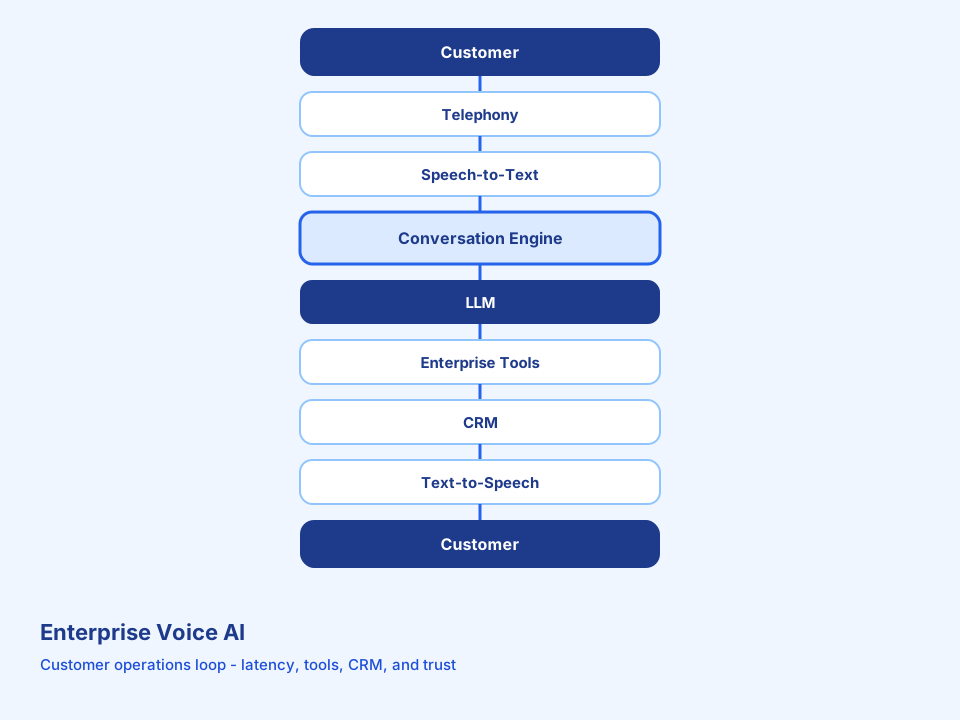
Customer speech flows through telephony and STT into a conversation engine that calls an LLM with enterprise tools, writes back to CRM, synthesizes speech, and returns audio—with monitoring, evaluation, and human fallback as first-class paths.
- Customer
- TelephonyCall ingress / egress
- Speech-to-TextStreaming transcription
- Conversation EngineOrchestration, memory, policies
- LLMIntent, reasoning, responses
- Enterprise ToolsDeterministic workflows
- CRMEnterprise data & actions
- Text-to-SpeechNatural spoken reply
- Customer
AI systems
Evaluation strategy
Production Voice AI lives or dies by evaluation. Model quality alone is not enough—conversation success, task completion, latency, hallucination risk, cost, and escalation quality decide whether the business case holds.
Task completion
Did tools complete the job—lookup, schedule, route, qualify—correctly?
Conversation success
Did the interaction resolve the customer’s intent without confusion or loops?
Latency
End-to-end and perceived turn latency across STT → LLM → TTS.
Tool success rate
Reliability of enterprise tool / API execution under real traffic.
Hallucination / groundedness
Ungrounded claims and unsafe actions caught before they reach customers.
Escalation rate
How often—and how cleanly—the system hands off to a human.
Customer satisfaction signals
Experience quality on completed and escalated conversations.
Cost per conversation
Unit economics so automation remains viable as volume grows.
AI systems
AI observability
If you cannot inspect a conversation end-to-end, you cannot operate Voice AI in production. Observability is how latency, cost, tool failures, and escalations become actionable.
Conversation traces
Full path visibility from telephony through STT, orchestration, tools, and TTS.
Prompt versions
Which prompt template and policy version produced each turn.
Tool execution logs
Inputs, outputs, latency, and failure modes for enterprise tools.
Latency dashboards
Per-hop and end-to-end latency so regressions are visible quickly.
Failure analysis
Structured diagnosis for timeouts, tool errors, and degraded speech quality.
Human escalation monitoring
When, why, and how often conversations leave the AI path.
Migration
Migration phases
Phase 1
Business opportunity
Where automation changes cost-to-serve, experience, and conversion.
Phase 2
Platform spine
Telephony → STT → conversation engine → LLM → tools → CRM → TTS.
Phase 3
Trust & evaluation bars
Latency, barge-in, guardrails, escalation, observability, eval loops.
Phase 4
Product integration
Wire into SaaS workflows and CRM actions.
Phase 5
Operate & improve
Regression evals, cost control, reliability drills.
Engineering
Key results
Judgment
What didn't work
Treating Voice AI as a model demo problem
Problem
Demos ignore latency, barge-in, hallucinations, cost, evaluation, and enterprise integration—none of which customer ops or revenue teams can tolerate.
Decision
Shifted ownership to platform standards: production bars, tool contracts, evaluation, and human escalation.
Moved to
Architecture and delivery discipline around real call paths and business outcomes.
Key engineering decisions
Why streaming instead of waiting for full responses?
Problem
Customers experience lag as product failure, even if the final answer is correct.
Why
Streaming across STT / LLM / TTS lowers perceived latency and makes turn-taking feel natural.
Pros
- Lower perceived latency
- More natural conversations
- Better stay-on-call rates
Cons
- More implementation complexity
- Harder partial-failure handling
Trade-offs
Higher orchestration complexity in exchange for conversations people stay on.
Result
Latency stayed a first-class shipping bar, not polish.
Why streaming + tool orchestration instead of sending every request straight to the LLM?
Problem
Naive “every turn → full LLM call” designs burn tokens, inflate cost, and still fail on enterprise actions.
Why
Orchestration can short-circuit, cache, or route to tools before paying for expensive inference—and make actions reliable.
Pros
- Lower latency on common paths
- Reduced token usage and inference cost
- Better reliability for enterprise workflows
Cons
- More engineering complexity
- Clear ownership of routing policies
Trade-offs
More platform investment; stronger unit economics and trust.
Result
Cost and latency became controllable platform properties—not accidents of prompting.
Why tool calling instead of prompting alone?
Problem
Enterprises need Voice AI to take reliable actions—schedule, route, look up—not only sound fluent.
Options
Prompting alone
Rejected because: Unstructured outputs, weak auditability, unreliable workflow execution.
Tool calling with structured outputs· Chosen
Chosen because: Deterministic workflows, clearer auditing, and safer enterprise actions.
Decision
Prompt-only flows are hard to audit, easy to hallucinate, and brittle for multi-step workflows.
Trade-offs
More platform complexity; far more trustworthy actions in production.
Result
Conversations can complete real work—not only chat.
Why versioned prompt templates?
Problem
Ad-hoc prompts create silent regressions when models, tools, or policies change.
Why
Templates make prompts operable—reviewable, evaluable, and releasable like code.
Pros
- Easier evaluation
- Safer model upgrades
- Clear ownership
Cons
- More maintenance
- Discipline required across teams
Trade-offs
Slightly more process; dramatically better change control.
Result
Conversation quality becomes a managed system, not tribal knowledge.
Why human handoff as a product feature?
Problem
Edge cases, sensitive issues, and regulatory risk make full automation the wrong default.
Why
Enterprise trust requires graceful escalation—not trapping customers in a broken loop.
Pros
- Enterprise trust
- Better outcomes on complex issues
- Safer compliance posture
Cons
- Needs clear escalation UX and routing rules
Trade-offs
Slightly lower automation rate; much higher willingness to deploy Voice AI.
Result
AI handles repetitive load; humans own judgment-heavy work.
Why a platform over one-off voice features?
Problem
Multiple products needing speech without shared foundations.
Why
One-off builds recreate latency, guardrail, evaluation, and reliability bugs in every squad.
Pros
- Reuse
- Consistent quality bar
- Faster new agents
Cons
- Upfront platform investment
Trade-offs
Slower first demo; faster second and third voice experiences.
Result
Voice capability compounds across the org.
Challenges I had to solve
Challenge
End-to-end latency across STT → LLM → TTS makes conversations feel broken if any hop stalls.
Solution
Streaming paths, latency budgets per turn, and production bars treated as release criteria.
Result
Voice work judged by conversational feel, not only answer quality.
Challenge
Hallucination detection and ungrounded claims destroy enterprise trust.
Solution
Prefer tool-backed actions, constrain prompts, and escalate when confidence or policy requires it.
Result
Fewer fluent-but-wrong outcomes in customer-facing calls.
Challenge
Prompt versioning and LLM model upgrades create silent regressions.
Solution
Versioned prompt templates, evaluation suites, and controlled model rollout.
Result
Changes to models and prompts become operable releases.
Challenge
Multi-turn memory and context window management break long conversations.
Solution
Explicit context policies in the conversation engine—what to keep, summarize, or drop.
Result
Longer conversations stay coherent without unbounded cost.
Challenge
Barge-in and interruptible speech are hard—and non-negotiable for natural voice UX.
Solution
Design turn-taking and cancellation into the conversation engine, not as a late UX patch.
Result
Customers can interrupt and redirect without fighting the system.
Challenge
Cost per conversation and tool reliability determine whether automation is economical.
Solution
Instrument cost and tool success rates alongside latency; design for recoverable tool failures.
Result
Platform decisions stay grounded in unit economics and reliability.
Challenge
Conversation evaluation is easy to postpone until production pain forces it.
Solution
Treat evaluation as a platform capability from the start—success, task completion, escalation, CSAT signals.
Result
Quality and business value stay measurable as volume grows.
Delivery
Risk mitigation
| Risk | Mitigation |
|---|---|
| Demo-quality only | Production latency, barge-in, and reliability bars |
| Hallucinated actions | Tool calling, guardrails, human escalation |
| Silent prompt / model regressions | Versioned templates + evaluation |
| Privacy / tenancy issues | Enterprise isolation and data policies |
| Cost blowups | Per-conversation cost observability |
| One-off product forks | Shared platform ownership |
Trust & reliability
Treat recovery, monitoring, evaluation, and escalation as architecture—not afterthoughts.
Integration risk
Clear contracts between conversation engine, tools, CRM, and product surfaces.
Org risk
Hiring and mentoring so ownership isn’t hero-dependent as AI systems evolve.
Organization
Engineering leadership
Director work here is platform leadership with a business mandate: cost-to-serve, conversion, and production trust.
40+
Engineers
Voice platform
Focus
Cross-functional
Planning
“Voice AI is a cost and revenue initiative—not a model showcase.”
Technical roadmap
Sequence platform capabilities against journeys that change cost and revenue.
Cross-team delivery
Keep platform and product squads shipping without thrash.
Hiring & mentoring
Build owners for production AI systems—not only feature tickets.
Stakeholder communication
Frame progress as availability, automation, conversion, and enterprise trust—not model demos.
Outcomes
Customer outcomes
Availability
24×7 conversational engagement beyond business hours
Support experience
Faster first response and clearer resolution paths
Trust
Complex issues still reach humans cleanly
Business outcomes
Cost-to-serve
Lower operational cost as repetitive work is automated safely
Automation
Increased automation on high-volume conversational intents
Revenue motion
Better lead qualification and 24×7 sales / onboarding engagement
Capacity
Higher support capacity without linear hiring
Engineering outcomes
Platform
Shared Voice AI platform across speech products
Agent framework
Reusable orchestration for faster new AI experiences
Delivery
Faster rollout of new voice agents with shared trust bars
Team outcomes
Ownership
Cross-team platform execution with clear contracts
Leadership
Roadmap, hiring, and stakeholder alignment on business outcomes
Transformation
What changed for customer operations
| Before | After |
|---|---|
| Support mainly during business hours | 24×7 AI conversational availability |
| Long waits and repetitive manual conversations | Instant engagement on common intents |
| Human-only conversations | AI-first with human escalation |
| Limited scalability without hiring | Scales support capacity without linear headcount |
| Sales / onboarding limited by agent availability | Always-on qualification and scheduling opportunities |
| Voice as demo / one-off feature | Voice as enterprise platform capability |
Leadership lessons
- Fund Voice AI for cost, revenue, and experience—not novelty.
- Treat latency, evaluation, barge-in, and escalation as product requirements.
- Platform beats one-offs when multiple products need speech.
- Director leverage is standards + people + sequencing around production trust.
What I'd do differently
- Instrument conversation-quality evals even earlier alongside latency and cost.
- Publish integration and escalation playbooks sooner for product teams.
Where it goes next
Continue strengthening Voice AI as a trusted business platform:
- Tighter latency and cost observability per conversation turn
- Stronger evaluation for conversation quality, task completion, and tool success
- Deeper product and CRM integrations for revenue journeys
- Harder reliability drills for failure and escalation paths
Biggest takeaway
Voice AI wins when it lowers cost-to-serve, grows engagement, and earns trust—
on a platform that makes reliability boring.
Key takeaways
- Enterprise Voice AI is a business transformation—cost, revenue, and experience—not an LLM demo.
- Trust is the product: latency, reliability, evaluation, guardrails, and human fallback.
Final reflection
Building enterprise Voice AI reinforced that successful AI systems are engineered, not prompted. Enterprises don’t adopt AI because it is impressive—they adopt it because it is reliable, measurable, secure, and capable of improving customer experience without sacrificing trust.
← All projects