Engineering case study
Building an Agentic AI Platform for Enterprise Workflow Automation
As Engineering Director, I lead Birdeye’s Agentic AI framework so enterprise products can plan, orchestrate tools, and complete multi-step workflows—onboarding, support resolution, internal operations—with evaluation and guardrails instead of calling a model and hoping.
Enterprise automation through reasoning, planning, and tool execution—not chat. Multi-step workflows with memory, verification, and guardrails.
“Agentic AI is reasoning + planning + tool execution. Conversation is optional; workflow completion is not.”
Why the business funded this
Traditional automation struggles when work is ambiguous or spans multiple systems. Birdeye needed Agentic AI to reason, plan, and execute multi-step business tasks—not only answer questions—on products contributing to $100M+ ARR, with reliability and governance enterprise customers expect.
My role
Engineering Director
Team
40+ engineers
Duration
Ongoing platform leadership
Business goal
Automate enterprise workflows
Primary outcome
Production Agentic AI platform
My contribution
Architecture · Leadership · Execution
Responsible for
- Agent framework architecture
- AI platform standards
- Shared evaluation framework
- Cross-team adoption
- AI governance
- Hiring & mentoring
- Product & stakeholder alignment
Multi-agent
Workflows
Tool
Orchestration
Enterprise
Automation
Production
AI platform
Engineering timeline
- Business opportunity
- Why agents
- Framework spine
- Eval & guardrails
- Product adoption
Business
Business impact
- Automates multi-step business workflows across customer and internal operations
- Reduces repetitive operational work that consumes skilled headcount
- Enables employees to focus on higher-value judgment tasks
- Improves consistency across customer interactions
- Speeds up internal and customer-facing processes
- Creates reusable AI capabilities across products—not one-off agents
Why this problem mattered
Traditional enterprise automation relies on predefined workflows that struggle when requests become ambiguous or require reasoning across multiple systems. As AI capabilities matured, businesses needed software that could plan, decide, use enterprise tools, and complete multi-step tasks rather than simply answering questions.
Agentic AI enables organizations to automate complex workflows such as customer onboarding, support resolution, internal operations, and employee assistance by combining reasoning, memory, and enterprise tool execution. This reduces manual effort, accelerates task completion, and allows businesses to scale operations without proportionally increasing headcount.
At Birdeye’s scale—products contributing to $100M+ ARR—that meant building a platform: shared orchestration, evaluation, observability, and guardrails so Agentic AI could become a reusable business capability, not a collection of impressive demos.
Business operations context
Traditional enterprise automation relies on brittle, predefined workflows. Birdeye’s Agentic AI platform is the shared substrate for goal-driven workflows: a planner agent coordinates memory, knowledge, tools, policies, and observability so products can complete multi-step tasks—and fail safely when they cannot.
The framework exists so product teams do not reinvent prompting, tool wiring, evaluation, and failure handling for every AI feature.
Delivery
Constraints
- Must complete real multi-step tasks—not only answer questions
- Must be adoptable by product teams—not only AI specialists
- Must support evaluation and guardrails for non-deterministic models
- Permission-aware tool execution and safe failure modes
- Cost per workflow must stay economically viable
- Cannot block product roadmap while the framework matures
- Prefer evolutionary architecture over a premature mega-framework
Leadership
Cross-functional collaboration
Agentic platforms only succeed when Product, Engineering, and governance stakeholders share one definition of production-ready.
- Partnered with Product on workflows that change cost-to-serve and cycle time
- Worked with engineering managers on adoption paths and ownership boundaries
- Aligned on evaluation expectations so “done” includes reliability, not a happy-path demo
- Framed AI governance for leadership: autonomy with checkpoints, auditability, and safe failure
- Collaborated across Product and adjacent stakeholders on sensitive-action policies where needed
Judgment
AI platform principles
- AI augments people—it does not replace judgment by default.
- Tool orchestration beats unbounded autonomy in enterprise contexts.
- Human approval is required for sensitive actions.
- Evaluation and observability are mandatory for production agents.
- Specialized agents beat one giant prompt.
- Frameworks earn adoption by making the reliable path the easy path.
Engineering goals
- Plan and execute multi-step enterprise workflows end-to-end
- Orchestrate tools reliably across systems—not free-form autonomy
- Support specialized agents that can evolve independently
- Verify outcomes before side effects become permanent
- Bake evaluation, observability, and guardrails into the platform
- Ship framework value incrementally with real product workflows
Architecture
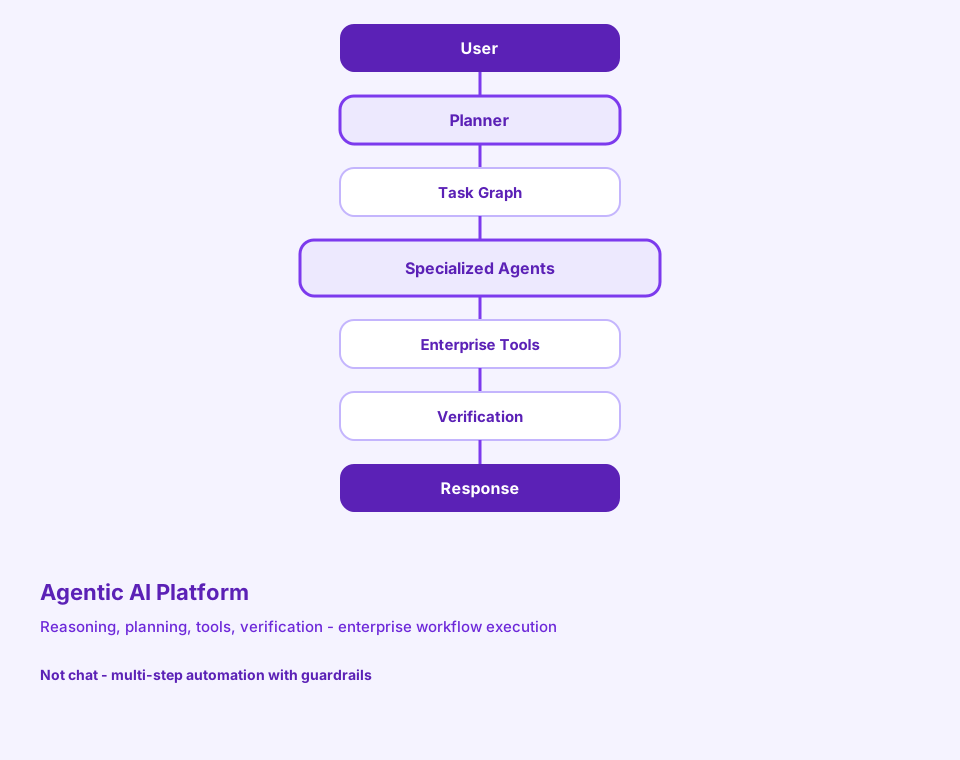
Emphasis is reasoning and execution: plan a task graph, run specialized agents, call enterprise tools, verify, then respond—not a single conversational turn.
A user goal becomes a plan. Specialized agents execute steps through enterprise tools. Verification and policies catch unsafe or incomplete work before the response ships.
- UserBusiness goal or request
- PlannerReasoning, decomposition, sequencing
- Task graphOrdered steps with dependencies
- Specialized agentsFocused capabilities, not one mega-prompt
- Enterprise toolsPermissioned actions across systems
- VerificationValidate outputs, retries, safe failure
- Response / outcomeCompleted workflow or clean escalation
AI systems
Evaluation strategy
Without evaluation, Agentic AI cannot improve—and cannot be trusted. Success is measured at the workflow level, not only at the prompt level.
Task completion rate
Did the agent finish the business workflow correctly end-to-end?
Planning accuracy
Did the planner choose sensible steps and stop when done?
Tool success rate
Did enterprise tools execute reliably under real conditions?
Hallucination rate
Ungrounded claims or invented actions caught before impact.
Escalation frequency
How often—and how cleanly—work returns to a human.
Latency
Time-to-complete for workflows users and operators care about.
Cost per workflow
Unit economics so automation remains viable as volume grows.
User satisfaction
Experience quality for completed and escalated workflows.
AI systems
AI observability
If you cannot inspect a multi-step agent run, you cannot operate it in production. Observability turns failures into learning.
Workflow traces
Step-by-step visibility from plan through tool calls to outcome.
Prompt & policy versions
Which templates and rules produced each decision.
Tool execution logs
Inputs, outputs, latency, and failure modes for enterprise tools.
Cost & latency dashboards
Per-workflow economics and performance regressions.
Failure analysis
Structured diagnosis for planning errors, tool failures, and loops.
Escalation monitoring
When and why workflows leave the autonomous path.
AI systems
AI guardrails
Enterprise agents need hard boundaries. Guardrails are how Agentic AI stays useful without becoming unsafe or unaccountable.
Permission-aware tool execution
Agents only call tools they are allowed to use for that tenant and role.
Human approval for sensitive actions
High-impact changes require an explicit checkpoint.
Prompt injection protection
Untrusted content cannot silently rewrite goals or tool policy.
Validation of tool outputs
Structured checks before side effects continue down the plan.
Retry and fallback logic
Transient failures recover; permanent failures escalate cleanly.
Safe failure behaviour
Prefer stop + escalate over inventing a confident wrong answer.
Migration
Migration phases
Phase 1
Business opportunity
Workflows where multi-step automation changes cost and cycle time.
Phase 2
Why agents
Where predefined scripts fail—ambiguity and cross-system reasoning.
Phase 3
Framework spine
Planner, memory, tools, policies, observability.
Phase 4
Eval & guardrails
Task completion, tool success, approvals, safe failure.
Phase 5
Product adoption
First real workflows on the shared platform.
Engineering
Key results
Judgment
What didn't work
Letting every team invent agent wiring independently
Problem
Inconsistent quality, duplicated effort, and failure modes that are hard to govern across enterprise products.
Decision
Invest in a shared Agentic AI framework with orchestration, evaluation, and guardrails as defaults.
Moved to
Incremental framework adoption tied to real multi-step business workflows.
One large autonomous prompt for complex workflows
Problem
Prompt complexity exploded; evaluation and ownership became impossible; failures were hard to localize.
Decision
Prefer specialized agents and explicit tool orchestration over unbounded autonomy.
Moved to
Planner + tools + policies with measurable steps and clear escalation.
Why not just call ChatGPT?
Because enterprise workflows are not chat. Calling a general model is not enough when work requires permissions, tools, memory, observability, retries, auditing, and deterministic enough execution to trust side effects in production systems.
ChatGPT can draft an answer. Agentic platforms must complete a workflow: plan the steps, use the right enterprise tools, remember prior context, verify results, escalate when uncertain, and leave an audit trail. Without that engineering stack, AI remains impressive—and unshippable for enterprise automation.
Key engineering decisions
Why multiple specialized agents instead of one large prompt?
Problem
Complex enterprise workflows overload a single prompt—and make evaluation and ownership nearly impossible.
Why
Specialized agents keep each step understandable, testable, and independently improvable.
Pros
- Better maintainability
- Independent evolution
- Easier evaluation
- Reduced prompt complexity
Cons
- More orchestration surface area
Trade-offs
Slightly more system design; far more operable production behavior.
Result
Teams can improve one capability without rewriting the whole agent.
Why tool orchestration instead of unbounded agent autonomy?
Problem
Fully autonomous agents can take expensive, incorrect, or unauditable actions in enterprise systems.
Why
Orchestration makes enterprise behavior predictable, auditable, and recoverable.
Pros
- Predictable enterprise behaviour
- Easier auditing
- Better reliability
Cons
- Slightly more orchestration code
Trade-offs
Less “magic”; much higher willingness to deploy into real products.
Result
Agents complete work through governed tools—not improvisation.
Why memory?
Problem
Multi-step workflows fail when every turn restarts from zero context.
Why
Memory preserves continuity across steps and reduces repeated context cost.
Pros
- Better personalization
- Multi-step workflow continuity
- Reduced repeated context
Cons
- More complexity
- Clear retention and tenancy rules required
Trade-offs
Additional platform responsibility; workflows that can finish.
Result
Agents stay coherent across longer enterprise tasks.
Why a shared framework over per-feature agents?
Problem
Without a platform, every AI feature reinvents prompting, tools, evaluation, and failure handling.
Why
Shared orchestration and guardrails make the second product cheaper than the first.
Pros
- Reuse
- Consistent quality bar
- Clear ownership
Cons
- Upfront platform investment
- Adoption work
Trade-offs
Slower first demo; faster, safer second and third workflows.
Result
Agentic capability compounds across the org.
Challenges I had to solve
Challenge
Non-deterministic models make “it worked once” a dangerous definition of done.
Solution
Evaluation and guardrail expectations as part of delivery—task completion, tool success, escalation.
Result
Reliability becomes discussable and enforceable.
Challenge
Planning errors and tool loops can burn cost and user trust quickly.
Solution
Orchestration policies, retries with limits, and safe stop/escalate behaviour.
Result
Failures degrade gracefully instead of thrashing.
Challenge
Product teams resist frameworks that feel heavy.
Solution
Optimize for developer experience and incremental adoption paths.
Result
Adoption through usefulness, not mandate theater.
Challenge
Governance and sensitive actions require more than good prompts.
Solution
Permission-aware tools, human approval checkpoints, and auditable traces.
Result
Enterprise stakeholders can trust what agents are allowed to do.
Delivery
Risk mitigation
| Risk | Mitigation |
|---|---|
| Agent sprawl | Shared orchestration framework |
| Unsafe autonomy | Guardrails + human checkpoints |
| Silent regressions | Evaluation + observability |
| Low adoption | DX-first incremental rollout |
| Cost blowups | Cost-per-workflow instrumentation |
Abstraction risk
Grow framework only where patterns repeat across products.
Quality risk
Evals, traces, and failure handling are first-class—not optional.
Delivery risk
Ship framework value with product workflow milestones.
Organization
Engineering leadership
Leading Agentic AI is platform leadership: standards, governance, adoption, and evaluation—not only shipping a clever agent demo.
40+
Org
Agent platform
Focus
Adoption-led
Mode
“If ChatGPT were enough, enterprises would not need permissions, tools, memory, or audit trails.”
AI platform standards
Shared orchestration, tool contracts, and failure defaults.
Shared evaluation framework
Task completion, tool success, cost, and escalation as norms.
Cross-team adoption
Make the reliable path the path of least resistance.
AI governance
Permissions, approvals, and auditable behaviour for enterprise trust.
Product collaboration
Sequence framework work against workflows that change operations.
Hiring & mentoring
Grow engineers who can own production AI systems responsibly.
Outcomes
Customer outcomes
Experience
Faster, more consistent multi-step interactions
Resolution
Workflows complete with clear escalation when needed
Business outcomes
Automation
Multi-step operational workflows handled by agents
Productivity
People focus on higher-value judgment work
Consistency
More repeatable outcomes across customer interactions
Leverage
Reusable AI capability across products on $100M+ ARR surfaces
Engineering outcomes
Platform
Shared agent orchestration substrate
Trust stack
Evaluation, observability, and guardrails as defaults
Delivery
Faster path to new agent workflows with shared patterns
Team outcomes
Adoption
Cross-team reusable patterns and clearer ownership
Governance
Platform standards teams can follow without reinventing safety
Transformation
What changed
| Before | After |
|---|---|
| Predefined scripts that break on ambiguity | Agents that plan and use tools across systems |
| Per-feature agent wiring | Shared Agentic AI framework |
| Demo-happy paths | Evaluation + guardrail expectations |
| Unbounded autonomy experiments | Orchestrated tools with human checkpoints |
| Fragmented ownership | Platform + product contracts |
Leadership lessons
- Explain Agentic AI as business workflow automation first—then architecture.
- Orchestration, evaluation, and guardrails beat unbounded autonomy.
- Frameworks must win adoption—or they become shelfware.
- Director leverage is standards + governance + sequencing around real workflows.
What I'd do differently
- Publish golden-path workflow examples earlier for product teams.
- Invest even sooner in automated eval suites for planning and tool success.
Where it goes next
Deepen the Agentic AI platform as a trusted operations capability:
- Stronger evaluation automation for planning and tool success
- Richer enterprise tool ecosystem
- Better observability per agent step
- Clearer contribution model for product teams
- Tighter cost-per-workflow controls
Biggest takeaway
Agents become a business platform when orchestration and guardrails are shared—
and when teams choose them because they ship safer, faster workflows.
Key takeaways
- Agentic AI is enterprise workflow automation with reasoning—not chat with extra steps.
- Production readiness is orchestration, evaluation, observability, and guardrails.
Final reflection
The biggest lesson was that successful Agentic AI systems depend less on increasingly capable models and more on thoughtful engineering. Planning, tool orchestration, evaluation, observability, and guardrails were the foundations that transformed AI from an impressive demo into an enterprise platform teams could trust.
← All projects