The 5 most common ways AI agents fail (and how to fix them)
Synthetic scenarios, error categorization checklists, Zod guardrails, and defensive orchestration patterns learned from hundreds of thousands of production runs.

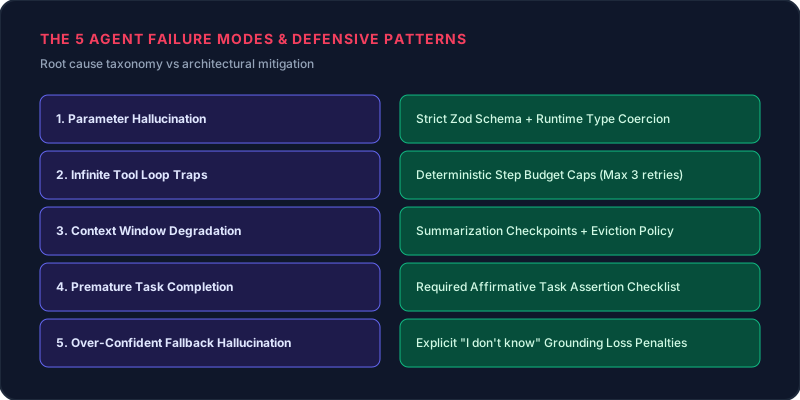
Why Autonomous Agents Degrade in the Wild
When you test an agent in isolation, it feels nearly human. When you connect that agent to real enterprise customer traffic, unpredictable edge cases proliferate.
Through hundreds of thousands of production agent runs, failures consistently cluster into five repeatable categories. Fixing these failure modes does not require waiting for next-generation frontier models—it requires defensive runtime engineering wrappers.
1. Parameter Hallucination and Semantic Drift
The model generates valid JSON syntax, but the parameter values violate fundamental business invariants. Examples include requesting negative quantities, booking dates that fall on company holidays, or passing arbitrary user strings into internal database ID fields.
Fix: Never pass raw model JSON into downstream services. Always pipe tool payloads through strict Zod schemas with custom semantic validation.
import { z } from "zod";

export const AppointmentBookingSchema = z.object({
  customerId: z.string().uuid("Invalid customer identifier"),
  serviceId: z.enum(["CONSULTATION", "FOLLOW_UP", "ENTERPRISE_DEMO"]),
  slotStartTime: z.string().datetime().refine((iso) => {
    const date = new Date(iso);
    const now = new Date();
    // Invariant: Bookings must be at least 2 hours in the future
    return date.getTime() > now.getTime() + 2 * 60 * 60 * 1000;
  }, { message: "Appointments must be scheduled at least 2 hours in advance." }),
  durationMinutes: z.number().int().min(15).max(60),
});
2. Premature Completion and Blind Affirmation
The agent declares a complex multi-step task complete when only the first step was executed. For instance, the user asks to cancel an existing order and refund the payment; the agent cancels the order status in the database but forgets to call the refund payment gateway, yet enthusiastically tells the user: 'I have successfully canceled your order and refunded your payment!'
Fix: Invariant State Gates. The system must verify that all required outcome markers (e.g., status === 'CANCELED' AND refundId !== null) are explicitly present in the verified context before the agent is allowed to emit a completion response.
3. The Infinite Tool Retry Loop
When an external API returns an error (e.g., 404 Not Found), the model re-invokes the same tool with subtle, cosmetic variations (adding punctuation, changing casing, or guessing parameters) hoping for a different outcome. Within 15 seconds, the agent burns 20,000 tokens in a loop.
Fix: Strict Tool Invocation Budgets and Semantic Variation Blockers. If a tool fails twice with equivalent semantic arguments, the tool is locked out for the remainder of the session, and the system transitions to a fallback state.
4. Context Window Degradation & Dump Bloat
When tools return 500-line JSON documents, those tokens remain in the conversational history for every subsequent turn. By turn 6, 85% of the model's context window is filled with obsolete tool dumps. The model loses attention on early system constraints and starts hallucinating instructions.
Fix: Ephemeral tool payload stripping. Store the full output in telemetry databases, but condense the prompt memory to a 3-line structured summary before calling the model on the next turn.
5. Over-Confident Fallback Fabrication
When a knowledge base search returns zero relevant chunks, an ungrounded model will often invent an plausible-sounding answer rather than admitting it lacks the information.
Fix: Hard Cosine Similarity Thresholds and Strict Abstention Prompts. If the vector search similarity falls below 0.82, the retrieval tier automatically injects a verified 'NO_DATA_AVAILABLE' flag into the prompt, triggering an explicit graceful handover.

Rohit Anand
Engineering Leader & Builder building enterprise platforms, Voice AI, and Agentic systems. Dedicated to evolutionary architecture, team judgment, and delivery excellence.