The state of Voice AI in 2026: from demos to daily use
What's working, what's not, and how to design voice agents people actually trust in business workflows.

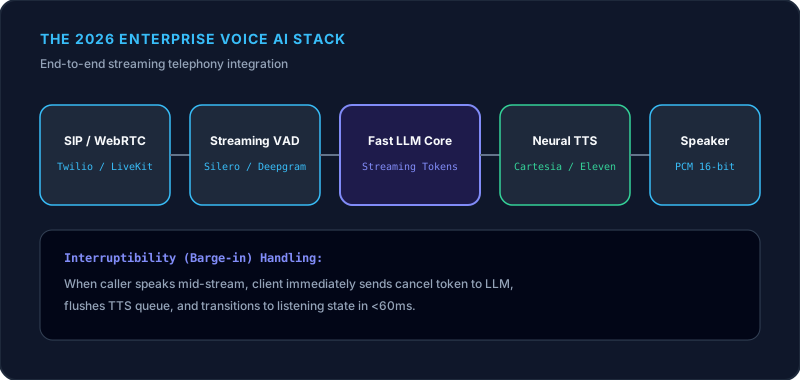
Moving Beyond Scripted Demos to Real World Telephony
In 2024, voice demos captured headlines with ultra-fast WebSocket demos running on fiber-optic connections in quiet office rooms. In 2026, the battle has shifted to the noisy real world: background lawnmowers, cell phone tower handoffs, heavy accents, and complex enterprise backends.
True enterprise utility requires voice systems that handle ambiguous speech, support natural barge-in without cutting off thoughtful pauses, and seamlessly transfer calls to human specialists when sentiment drops.
Callers do not speak in neat, complete paragraphs. They hesitate, correct themselves ('actually, make that 3 PM, not 2'), and insert conversational filler. A production voice agent must process these acoustic signals in real time without triggering premature model inference.
Never assume studio-quality audio in production. Cell network packet loss, 8kHz G.711 narrow-band codecs, and ambient background noise will degrade speech-to-text accuracy by 25% without adaptive front-end filtering.
Acoustic Intelligence vs Pure LLM Generation
The biggest leap in 2026 Voice AI is emotional prosody and conversational cadence. Rather than treating speech synthesis as flat text read aloud, modern voice models adapt pitch, speed, and breathing pauses dynamically depending on whether they are confirming an urgent medical record or casually scheduling a test drive.
When a caller speaks softly or sounds distressed, the agent lowers its playback volume and introduces sympathetic pacing, establishing rapport that flat text-to-speech could never achieve.
Conversational Turn-Taking State Machines
The core differentiator between a clunky voice bot and a fluid human-like assistant is the turn-taking state machine. If the silence threshold is set to 300ms, the bot constantly interrupts human pauses. If set to 1,000ms, the conversation feels sluggish and unresponsive.
We implemented an adaptive Voice Activity Detection (VAD) classifier that dynamically adjusts the pause threshold based on syntactic completeness: if the caller ends on a rising intonation or conjunction ('because...'), the system extends the pause window to 850ms. If they conclude a complete declarative sentence, it dispatches generation in 400ms.
// Dynamic turn-taking silence threshold calculator
interface TurnTakingConfig {
  baseSilenceMs: number;
  incompleteClauseMs: number;
  questionPauseMs: number;
}

export function computeAdaptiveSilenceThreshold(
  lastPartialTranscript: string,
  config: TurnTakingConfig = { baseSilenceMs: 450, incompleteClauseMs: 900, questionPauseMs: 650 }
): number {
  const trimmed = lastPartialTranscript.trim().toLowerCase();

  // Trailing conjunctions or hesitation markers require longer grace periods
  const trailingConnectors = /(and|or|but|because|if|so|uh|um)$/;
  if (trailingConnectors.test(trimmed)) {
    return config.incompleteClauseMs;
  }

  // Interrogative sentences require standard conversational pause
  if (trimmed.endsWith("?")) {
    return config.questionPauseMs;
  }

  return config.baseSilenceMs;
}
WebRTC vs SIP Trunking: The Carrier Latency Tradeoff
Web applications can use WebRTC with high-fidelity Opus codecs running at 48kHz for sub-150ms round-trip audio transport. But traditional enterprise phone calls arrive over PSTN and SIP trunks constrained to 8kHz μ-law audio.
Bridging these two worlds requires media gateways placed at the network edge close to carrier exchange points. Running audio transcoding directly on the edge server saves 90ms of transport latency before audio packets ever touch the inference pipeline.
Operational Resilience & Warm CRM Handoffs
Building voice for business operations means treating telephony drops and carrier jitter with the same rigorous observability as primary database replicas. When an audio stream degrades, the system must adapt bitrate smoothly without dropping conversational state.
Crucially, when caller sentiment drops below acceptable thresholds, the system executes an automated SIP transfer to human agents, transmitting the real-time transcript and extracted intent directly to the agent's CRM screen so no context is lost.

Rohit Anand
Engineering Leader & Builder building enterprise platforms, Voice AI, and Agentic systems. Dedicated to evolutionary architecture, team judgment, and delivery excellence.