My AI toolkit for solo builders
The exact tools, local models, SDKs, and observability stacks I use to research, prototype, and ship.
The Core Modern Solo Stack: High Leverage, Zero Bloat
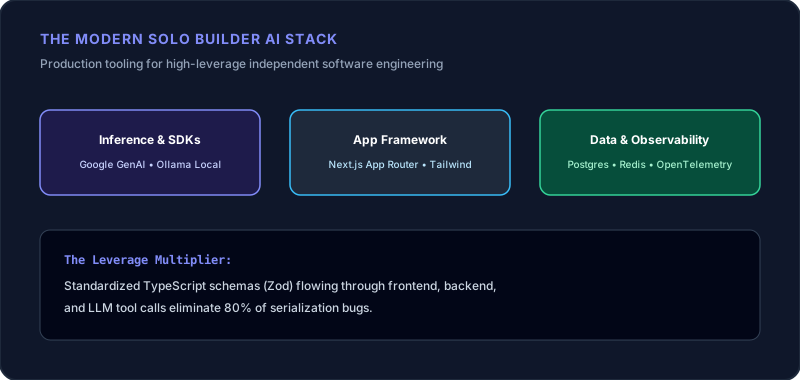
Building production-grade applications as an individual engineer requires a stack optimized for velocity, type safety, and minimal operational overhead:
• Fullstack Web Framework: Next.js App Router with TypeScript and Tailwind CSS for rapid server-rendered component delivery. • AI Inference: Official Google GenAI SDK for fast multimodal reasoning, structured JSON schemas, and streaming outputs. • Local Development: Ollama for rapid offline testing, mock generation, and cost-free unit test evaluation. • Data Layer: PostgreSQL with Drizzle ORM for type-safe relational schemas and Redis for semantic vector caching. • Observability: OpenTelemetry with structured trace logging, giving enterprise-level debugging on a solo budget.
Avoid monolithic frameworks that wrap HTTP calls and prompt strings in five layers of abstractions. Choose lightweight, modular libraries where you retain total visibility.
Fullstack Architecture Blueprint
Our architecture unifies frontend components, backend API routes, and AI inference under shared TypeScript type definitions and Zod schemas. This end-to-end type safety eliminates 80% of serialization bugs.
// Unified fullstack client with Google GenAI SDK
import { GoogleGenAI, Type } from "@google/genai";

const ai = new GoogleGenAI();

export async function generateStructuredPlan<T>(
  prompt: string,
  responseSchema: any
): Promise<T> {
  const response = await ai.models.generateContent({
    model: "gemini-2.5-flash",
    contents: prompt,
    config: {
      responseMimeType: "application/json",
      responseSchema,
      temperature: 0.1,
    },
  });

  return JSON.parse(response.text) as T;
}
Offline Prototyping vs Production Cloud Inference
When prototyping new features on a plane or in a cafe, I run local models via Ollama. This allows immediate feedback loops without network latency or API meter anxiety.
Once the prompt contract and schema validation are hardened against local fixtures, switching to cloud inference in production requires altering just a single environment variable.
Observability and Semantic Debugging on a Solo Budget
Solo builders often neglect telemetry until their first production outage. By wiring structured JSON logging directly to OpenTelemetry from day one, you get complete visibility into token consumption, latency bottlenecks, and error rates without paying for enterprise SaaS observability suites.
Principles of Radical Simplicity
The fastest code is the code you never have to write or debug. Pick tools with active open-source communities, stable APIs, and clean documentation. Every dependency you add is an operational commitment—keep your surface area minimal and your product leverage immense.

Rohit Anand
Engineering Leader & Builder building enterprise platforms, Voice AI, and Agentic systems. Dedicated to evolutionary architecture, team judgment, and delivery excellence.