How I use AI to ship faster (my daily builder workflow)
A behind-the-scenes look at the tools, prompts, testing harness, and habits that accelerate idea to production.
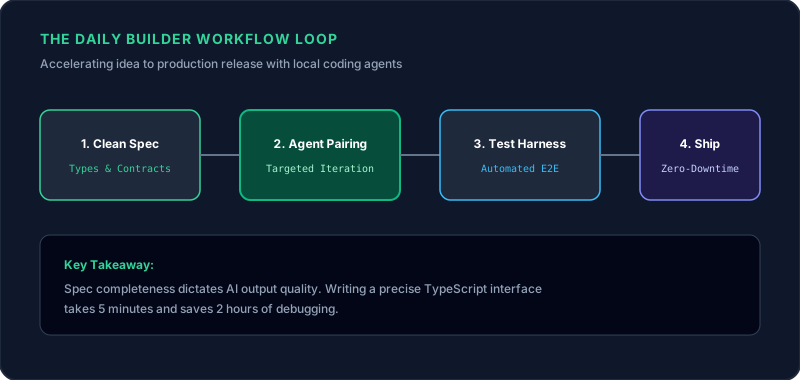
The Four-Step Daily Builder Loop
My daily engineering workflow centers on high-leverage agent pairing, moving rapidly from idea to verified production deployment:
1. Precise Type Specification: Before invoking any model, write clean TypeScript interfaces and Zod schemas that define the exact data contract. 2. Iterative Agent Implementation: Delegate boilerplate and function implementations to local coding agents constrained to single files. 3. Automated Regression Harness: Verify every change immediately with unit tests and type checks before reviewing diffs. 4. Atomic Production Deploys: Push small, verifiable pull requests continuously rather than massive batch releases.
Never ask an AI model to write logic before you have written the TypeScript types and the failing unit test. Contracts constrain hallucination.
Context Discipline: The Key to Deterministic Agent Code
Never dump your entire repository into an agent's context. Passing 50 files confuses the model's attention mechanism and produces subtle hallucinated imports. Pass only the relevant contract types, active tests, and specific documentation.
Tighter context windows yield faster responses, lower hallucination rates, and deterministic code that compiles on the first attempt.
Test-Driven Agent Pairing Pattern
When implementing complex business logic, I write the test suite first using Vitest. The test specifies the boundary inputs, expected transformations, and error throws. Then I prompt the coding agent with a strict task: 'Implement the function that makes this test pass without modifying the test file.'
// Test contract passed directly to coding agent
import { describe, it, expect } from "vitest";
import { calculateInvoiceProration } from "./billing";

describe("calculateInvoiceProration", () => {
  it("computes exact day-prorated refund on plan downgrade", () => {
    const result = calculateInvoiceProration({
      currentPlanCents: 10000,
      newPlanCents: 5000,
      daysRemainingInCycle: 15,
      totalDaysInCycle: 30,
    });
    // Invariant: 15/30 = 50% delta -> 50% of (10000 - 5000) = 2500 cents
    expect(result.netCreditCents).toBe(2500);
    expect(result.nextBillingDate).toBeDefined();
  });
});
Atomic Commit Cadence and Bisectability
Because AI agents generate code rapidly, git histories can easily become messy blobs. I enforce a strict atomic commit discipline: every single prompt iteration that passes tests becomes an isolated git commit with a structured summary.
If a subtle bug slips through, git bisect pinpoints the exact prompt iteration in minutes.
Cognitive Energy Management for Solo Builders
The most valuable asset for a solo builder is uninterrupted creative focus. Offloading mechanical tasks—such as generating mock fixtures, writing CSS classes, or building schema migrations—preserves cognitive energy for high-leverage architectural and product decisions.

Rohit Anand
Engineering Leader & Builder building enterprise platforms, Voice AI, and Agentic systems. Dedicated to evolutionary architecture, team judgment, and delivery excellence.