What I've learned about engineering leadership in the age of AI
On building high-performing teams, avoiding shiny-object syndrome, and creating durable product leverage.

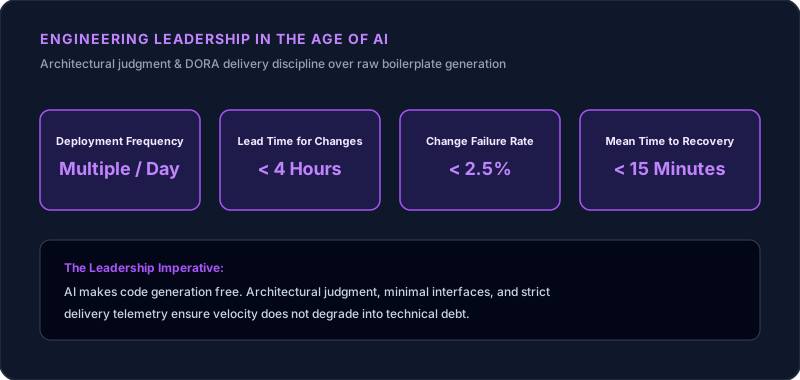
Engineering Judgment Over Raw Code Generation
In a world where coding agents can generate hundreds of lines of boilerplate in seconds, the bottleneck of software engineering has shifted completely. Writing code is cheap; reading, verifying, debugging, and maintaining code is where the cost lives.
As an engineering leader, I evaluate engineers not on the volume of code they emit, but on their architectural judgment: knowing what NOT to build, keeping dependencies minimal, and designing clear interfaces that survive model transitions.
Never let AI velocity create permanent accidental complexity. If an architecture cannot be explained in two minutes without hand-waving, it fails the production test.
DORA Signals and Blameless Operational Rhythm
Adopting AI requires more discipline, not less. We tie developer tooling and automated test suites directly to DORA delivery metrics—Deployment Frequency, Lead Time for Changes, Mean Time to Recovery, and Change Failure Rate.
When teams use AI with structured CI/CD guardrails and telemetry, cycle times drop by 40% without compromising reliability.
PR Review Protocol for AI-Assisted Codebases
When engineers use AI coding assistants without disciplined review gates, pull requests swell with unnecessary dependencies, hallucinated utility functions, and subtle edge-case omissions. We instituted a standardized PR checklist that every engineer must verify before requesting peer review.
### AI-Assisted Contribution Review Invariants
- [ ] Contract Verifiability: Are all inputs/outputs validated with runtime schemas (Zod)?
- [ ] Zero Accidental Complexity: Could this be solved with standard library primitives?
- [ ] Automated Test Coverage: Does this PR include failing tests that pass only with this change?
- [ ] Explicit Error Boundaries: Are API failures and timeouts handled gracefully without silent swallows?
- [ ] Hallucination Audit: Have all package dependencies and versions been verified in package.json?
The Two-Minute Architectural Rule
If a newly introduced agent workflow or microservice architecture cannot be explained and sketched by its author in two minutes on a whiteboard, it is rejected. High velocity must never become an excuse for architectural opacity.
The Human Moat: Empathy, Taste, and Accountability
Models have no skin in the game. They do not feel the customer's pain when billing fails at 2 AM, nor do they possess the taste to kill a feature that adds cognitive weight to a product. As leaders, our job is to foster deep product taste and ownership in our teams—letting AI handle the mechanical plumbing while humans steer the vision.

Rohit Anand
Engineering Leader & Builder building enterprise platforms, Voice AI, and Agentic systems. Dedicated to evolutionary architecture, team judgment, and delivery excellence.