Engineering case study
Unity Startup Simulator
A Unity simulation that teaches founder decision-making through play—not another lecture about startups.
In one sentence
I designed and built a Unity simulation that makes founder tradeoffs feel real by showing how decisions compound over time.
Role
Founder
Owned game design, systems modeling, Unity engineering, and player feedback loops.
Engineering timeline
- Idea
- Core loop
- Economy model
- Vertical slice
- Playtesting
Role
Founder
Timeline
2025–2026
Status
In progress
Platform
Unity · Desktop
Team
Solo founder
Users
Playtesting
Why this problem mattered
Most founders learn strategy through expensive failure. Startup advice is often abstract, contradictory, or too late to be useful. Spreadsheets and case studies rarely make tradeoffs feel real.
I wanted to build something that compresses the feedback loop—so aspiring founders can feel how one decision today shapes runway, team health, and product momentum months later.
Overview
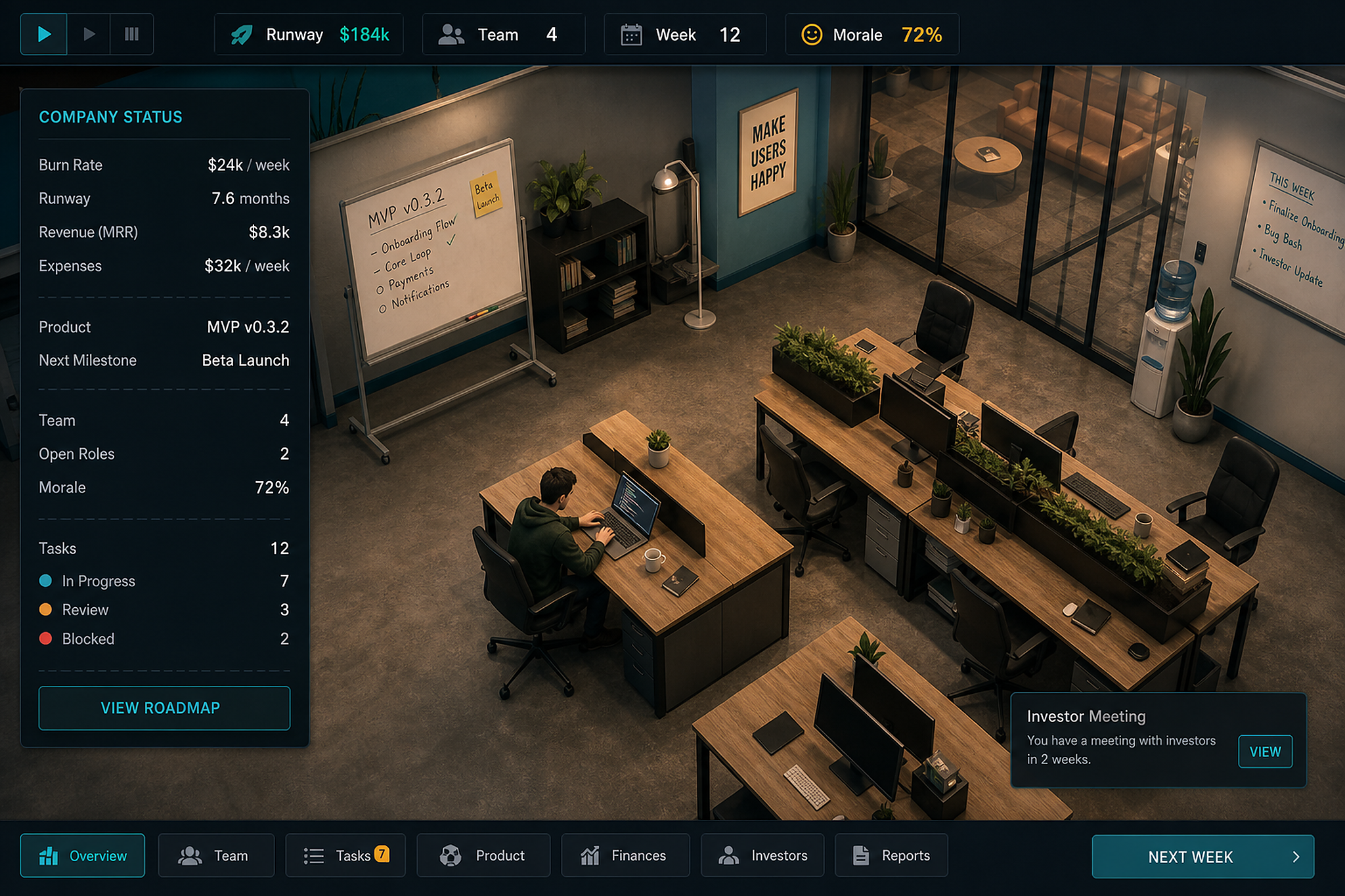
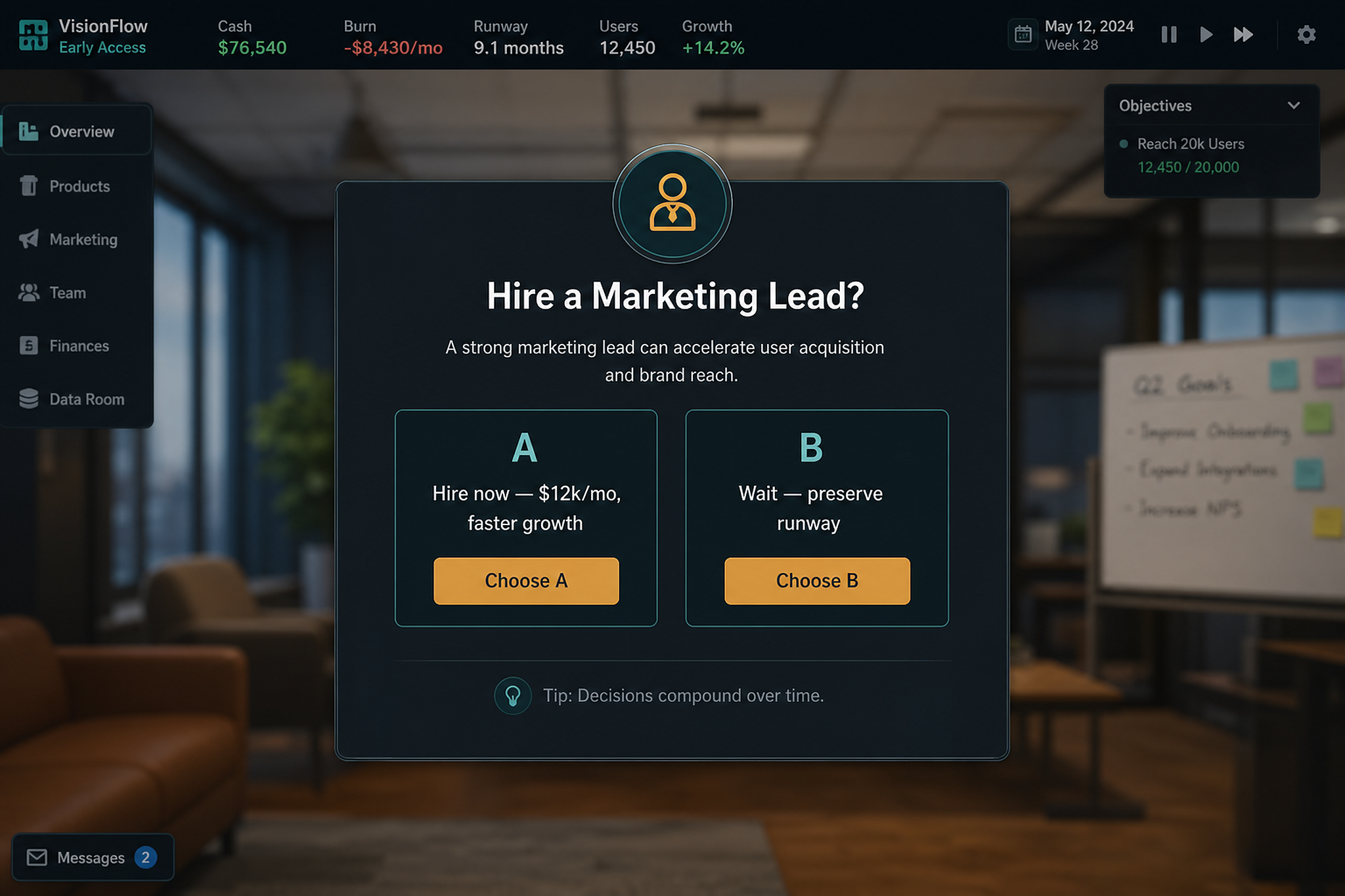
Unity Startup Simulator is an interactive game that models founder decisions—hiring, runway, product focus, and growth—and shows how those choices compound. Instead of abstract advice, players learn systems thinking by living the consequences.
What I owned
I led the project end-to-end as a solo founder, from defining the learning experience to building and iterating the simulation.
- Game design and learning goals
- Systems and economy modeling
- Unity / C# implementation
- UI that makes consequences legible
- Difficulty balancing and playtesting
Goals
- Make systems thinking tangible through play
- Keep gameplay engaging without spreadsheet fatigue
- Ship a vertical slice before content breadth
- Make every decision's consequences readable
How it works
Every play session runs through the same path—players make decisions, the simulation updates state, and the UI shows why outcomes changed.
The Unity client owns the experience. A simulation state model tracks runway, team, product, and market pressure. Decision events update that model, and feedback UI makes the consequences clear.
- Unity client
- Simulation state model
- Decision events
- Economy & progression
- Feedback UI
Engineering
Highlights
Core gameplay loop
What players actually do: pick a business idea, decide where to spend limited money, react to market events, balance growth and survival, and try to build a sustainable company.
- Start company
- Choose product
- Hire team
- Launch
- Revenue changes
- Customer feedback
- Next decision
Product & engineering decisions
Simplified economy for learning clarity
Why
A fully realistic market obscures the lesson. Players need to see cause and effect—not get lost in noise that looks sophisticated but teaches nothing.
Pros
- Clearer cause-and-effect learning
- Faster iteration on the core loop
- Less cognitive overload
Trade-offs
Clarity of systems over perfect simulation fidelity.
Vertical slice before content breadth
Why
A wide catalog of scenarios without a legible core loop wastes effort. One strong loop teaches more than many shallow ones.
Pros
- Sharper product taste
- Faster playtest feedback
- A shippable learning experience sooner
Trade-offs
Depth of one loop over many shallow scenarios.
Readable feedback over hidden math
Why
If players can't see why a choice mattered, the simulation becomes a black box—and learning collapses.
Pros
- Stronger learning moments
- Easier balancing
- More trust in the model
Trade-offs
Some complexity stays off-screen so the lesson stays clear.
Challenges I had to solve
Challenge
Opaque simulation outcomes destroy learning.
Solution
Readable feedback that ties each decision to concrete consequences—runway, team, and product momentum.
Result
Players can see why a choice mattered.
Challenge
Balancing difficulty without frustration.
Solution
Iterate the economy and decision pacing against real playtests.
Result
A tighter learning curve for the core loop.
Challenge
Modeling complex systems without spreadsheet fatigue.
Solution
Use a simplified economy and highlight only the levers that teach the lesson.
Result
Gameplay stays engaging while still teaching real tradeoffs.
Current snapshot
Outcomes
Primary outcome
Help aspiring founders see that every decision has tradeoffs—not one “correct” answer
Current stage
Vertical slice in playtesting
Platform
Unity · Desktop
Core experience
Founder decisions with compounding outcomes
Design philosophy
Clarity of systems over simulation fidelity
Built by
Solo founder — design, systems, and engineering
Lessons learned
Building the Startup Simulator reinforced that good learning design isn't about more realism—it's about making tradeoffs visible, consequential, and hard to ignore.
- Feedback design is as important as the underlying model.
- Constraints force sharper product taste.
- Players learn from consequences they can see—not math they can't.
- Ship one legible loop before expanding the world.
What I'd do differently
- I'd instrument player learning moments earlier.
- I'd separate tutorial scenarios from the full economy sooner.
- I'd define pass/fail learning outcomes before expanding content.
Where I'd take it next
If I continued investing here, I'd focus on:
- Richer scenarios and difficulty modes
- Better analytics on player learning moments
- Clearer tutorial paths for first-time founders
- More expressive feedback for delayed consequences
- Optional multiplayer advisor modes
Biggest takeaway
The hardest part wasn't building the simulation—
it was deciding what to hide, and how to make every decision feel consequential.
← All projects