Engineering case study
MyMindNook
A privacy-first AI companion that helps people slow down, reflect, and build healthier habits through conversations that remember what matters.
In one sentence
I designed and built a privacy-first AI companion that helps people reflect and build healthier habits through conversations that remember what matters.
Role
Founder
Built product strategy, engineering, AI systems, and deployment.
Engineering timeline
- Idea
- Prototype
- Private beta
- Voice conversations
- Long-term memory
Role
Founder
Timeline
2025–2026
Status
Private beta
Platform
Flutter · iOS + Android
Team
Solo founder
Users
Private beta
Why this problem mattered
Many people want someone to talk to, but therapy isn't always available, affordable, or something they need every day. Existing wellness apps often feel cold, complicated, or ask for too much personal data.
I wanted to build something that feels supportive, respects privacy, and is available whenever someone needs it.
Overview
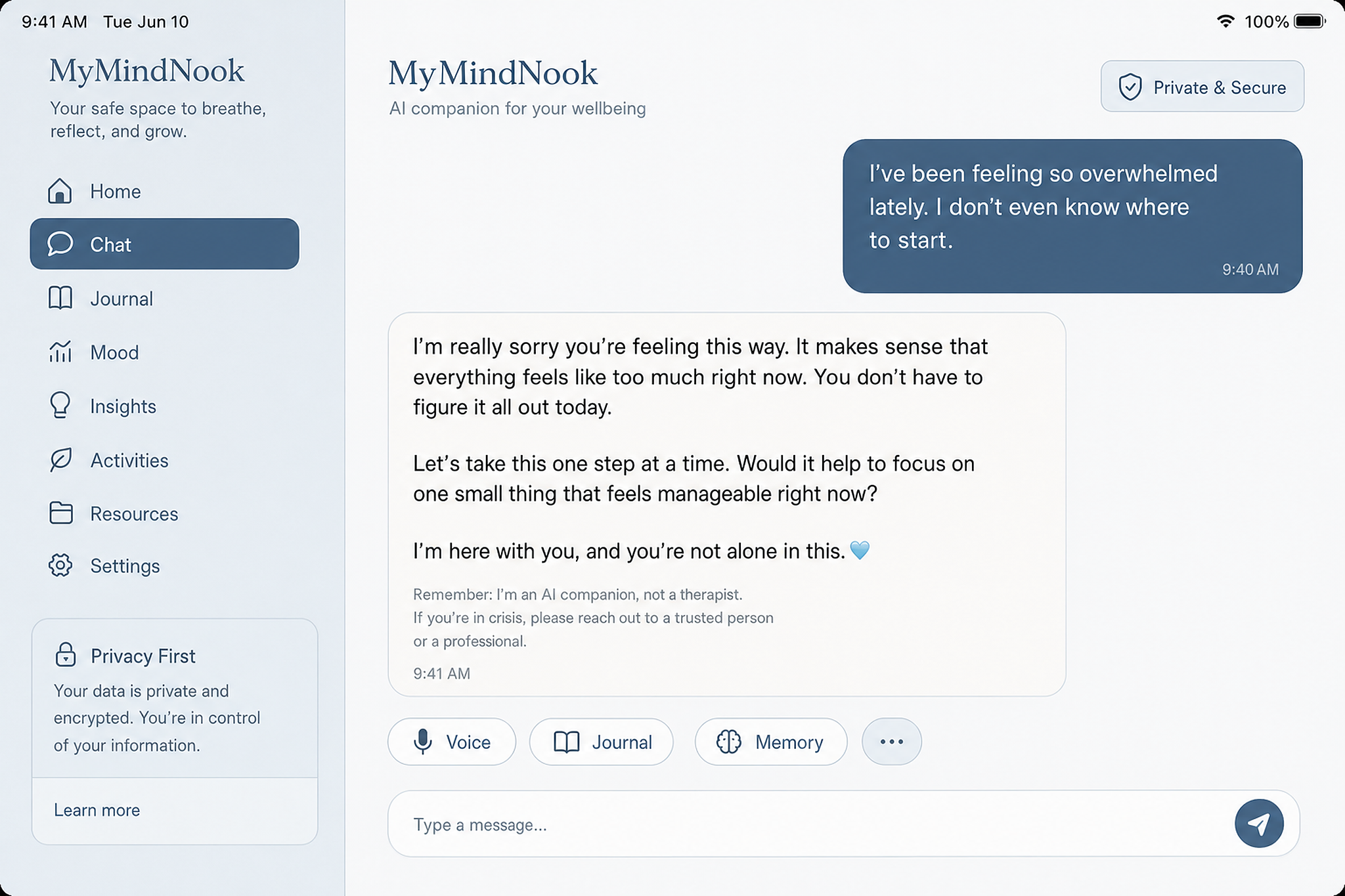
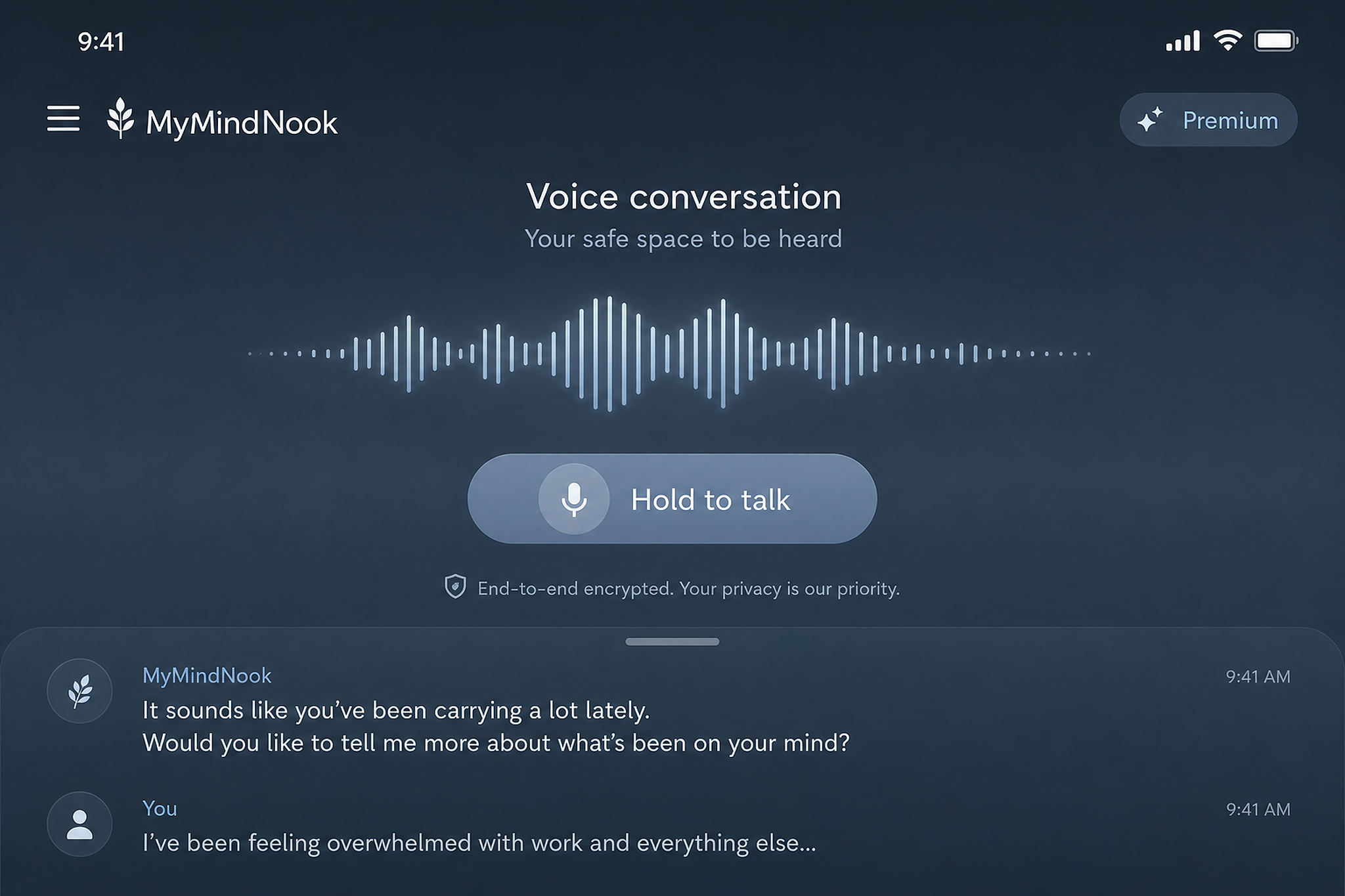
MyMindNook is an AI companion that helps people slow down, reflect, and understand their thoughts. It combines journaling, conversations, voice, and memory so users can build healthier emotional habits over time—all while keeping privacy at the center.
What I owned
I led the product end-to-end as a solo founder, from defining the experience to building and shipping the platform.
- Product design and planning
- Flutter app development
- Backend and cloud services
- AI conversations and memory
- Prompt design
- Production deployment and monitoring
Goals
- Keep the experience private by default
- Make conversations feel fast and responsive
- Create a simple mobile-first experience
- Keep AI affordable as the product grows
- Keep the system simple enough for one person to build and maintain
How it works
Every conversation follows the same simple path—from the mobile app to a lightweight AI service and then to the language model. This keeps responses secure, consistent, and easy to improve over time.
The goal wasn't to build a complicated AI platform—it was to build something reliable, secure, and easy to improve over time.
The app is built with Flutter and stores data securely using Firebase. When users chat, requests go through a lightweight AI service before reaching the language model.
- Flutter app
- Secure sign-in (Firebase)
- Private data storage
- Lightweight AI service
- Language model
- Memory of important moments
- Monitoring and crash reporting
Engineering
Highlights
Product & engineering decisions
Why Firebase?
Why
I wanted to spend my time building the product—not managing servers. Firebase gave me authentication, storage, and deployment out of the box, while still leaving room to grow later.
Pros
- Faster development
- Built-in authentication
- Reliable hosting
- Less infrastructure work
Trade-offs
Less flexibility than managing my own backend—but the speed was worth it.
Keeping conversations safe
Why
Instead of letting the AI answer everything, I gave it clear rules about what it should and shouldn't do. This made conversations more reliable and reduced the chance of unsafe responses.
Pros
- More reliable conversations
- Clearer safety boundaries
- A more consistent tone
Trade-offs
Less open-ended chat—but trust mattered more than unlimited answers.
Helping the AI remember what matters
Why
People don't want to repeat their story every time they open the app. Instead of saving every conversation forever, I summarize important moments so the AI remembers what matters while keeping costs under control.
Pros
- Conversations feel more personal
- AI costs stay predictable
Trade-offs
Remembering the right things beats saving everything.
One experience across voice and text
Why
Whether someone types or speaks, the same safety checks and AI rules are applied. That keeps the experience consistent across the app.
Pros
- One set of rules for text and voice
- A consistent experience
Trade-offs
Voice has tighter speed limits—but consistency was more important.
Challenges I had to solve
Challenge
Users expected the AI to remember earlier conversations without repeating themselves.
Solution
I introduced long-term memory that saves important moments instead of every message.
Result
Conversations felt much more personal without increasing AI costs.
Challenge
Building trust without pretending to replace professional care.
Solution
Clear boundaries about what the AI can and cannot do.
Result
The experience felt supportive without overpromising.
Challenge
Mobile networks aren't always reliable.
Solution
Better loading states, retries, and graceful error handling.
Result
Users could continue conversations without frustration.
Current snapshot
Outcomes
Current stage
Private beta
Available on
iOS and Android
Core experience
Journaling, voice conversations, and long-term memory
Reliability
Crash-free experience prioritized from day one
Cost
Designed to keep AI costs predictable as usage grows
Built by
Solo founder — product, engineering, and AI
Lessons learned
Building MyMindNook reinforced that trust isn't created by sophisticated AI—it comes from predictable behavior, clear boundaries, and consistently useful conversations.
- Trust isn't something you add later. Privacy, reliability, and clear AI behavior are features—not checkboxes.
- Good memory is about remembering the right things—not everything.
- Clear limits make AI products better, not worse.
- Start with one feature people genuinely love before adding more AI capabilities.
What I'd do differently
- I would simplify the memory system even further now that I understand how people actually use the product.
- I'd invest earlier in automated testing for AI conversations to make changes with more confidence.
- I'd wait longer before adding secondary features until the core companion loop felt unmistakably sticky.
Where I'd take it next
If I continued investing here, I'd focus on:
- Make conversations feel even faster
- Improve conversation quality using automated testing and feedback
- Add stronger personalization while protecting privacy
- Shared memories across devices
- Voice-first conversations
- Personalized daily reflections
- Better AI evaluation
- Open-source parts of the platform that can help other builders
Biggest takeaway
The hardest part wasn't building the AI—
it was building something people could trust enough to use every day.
← All projects