Engineering case study
Birdeye UI/UX Platform
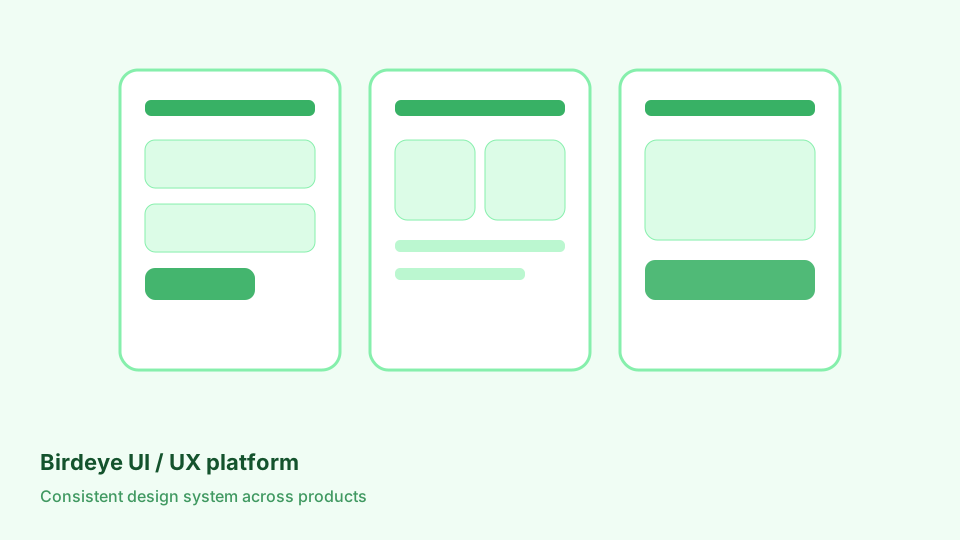
As Engineering Lead → Director, I launched Birdeye’s UI platform so consistency became a product capability—reducing design and engineering duplication while customers experienced one familiar interaction model across Social, Insights, and Campaigns.
Product platform strategy through standardization—shared UI patterns so Social, Insights, and Campaigns felt like one Birdeye, not mismatched products.
Why the business funded this
As Birdeye expanded across multiple products, inconsistent interfaces increased design effort, slowed feature development, and created a fragmented customer experience. A shared UI platform reduced duplication while allowing teams to ship new experiences with a familiar interaction model.
My role
Engineering Lead → Director
Team
Engineering + Product + Design
Duration
Multi-year platform program
Business goal
One coherent Birdeye experience
Primary outcome
Shared UI platform across products
My contribution
Architecture · Standardization · Cross-team adoption
Responsible for
- UI platform ownership
- Design-system partnership
- Cross-product adoption
- Engineering standards
- Stakeholder alignment
Engineering timeline
- Product UI drift across teams
- UI/UX program launch
- Shared patterns & components
- Cross-product consistency
- Coherent enterprise experience
Role
Engineering Lead → Director
Company
Birdeye
Focus
UI platform standardization
Products
Social · Insights · Campaigns
Approach
Design system + shared patterns
Live
birdeye.com
Why this problem mattered
Enterprise customers don’t experience “teams”—they experience the product. Inconsistent UI slows adoption, increases support burden, and makes every new surface feel unfamiliar.
As Birdeye expanded across multiple products, inconsistent interfaces increased design effort, slowed feature development, and created a fragmented customer experience. A shared UI platform reduced duplication while allowing teams to ship new experiences with a familiar interaction model.
Launching a UI/UX program with design-system discipline was how we made consistency a platform capability—and a commercial advantage—instead of a per-feature hope.
Overview
Birdeye ships multiple customer-facing enterprise products—Social, Insights, Campaigns, and more. As those products grew, customers needed a consistent UI/UX language: familiar patterns, predictable interactions, and a coherent visual system across the platform.
Goals
- Make Birdeye products feel consistent across journeys and teams
- Replace one-off UI with shared, reusable patterns
- Give Design, Product, and Engineering a common system language
- Scale UI quality as more enterprise products launched
How consistency scaled
Consistency came from a shared system—not from asking every team to “try harder” on visual polish.
A UI/UX program defined shared patterns and components, then product teams adopted them across Social, Insights, Campaigns, and related surfaces so customers met one coherent Birdeye experience.
- Product + Design + Engineering alignment
- UI/UX program & principles
- Shared components & patterns
- Adoption across product teams
- Consistent product surfacesSocial · Insights · Campaigns
Engineering
Highlights
From one-off screen to shared pattern
When a product needed a new surface, the default shifted from inventing UI to extending the system.
- Identify the customer journey and existing patterns
- Reuse or extend design-system components
- Align interaction behavior with Product & Design
- Ship on the shared UI foundation
- Feed improvements back into the system
Why not let each product team design freely?
Local speed creates global incoherence. Without a shared UI/UX system, every launch adds another dialect of Birdeye—and enterprise customers pay the cognitive cost.
UI/UX decisions
Launch a dedicated UI/UX consistency program
Why
Consistency doesn’t emerge from good intentions—it needs ownership, shared artifacts, and adoption across teams.
Pros
- Clear platform-level ownership of UI quality
- Reusable patterns instead of one-off screens
- Stronger partnership with Design
Trade-offs
Upfront coordination cost before every surface looks aligned.
Shared components over visual freedom
Why
Enterprise SaaS trust comes from familiarity. Shared components make the product feel intentional.
Pros
- Faster UI delivery once the system exists
- More predictable interactions for customers
- Easier cross-team collaboration
Trade-offs
Teams give up some one-off visual inventiveness.
Consistency tied to product launches
Why
Design-system work sticks when it ships with real products—Social, Insights, Campaigns—not as a side gallery.
Pros
- Immediate customer impact
- Adoption under real delivery pressure
- Credibility with product teams
Trade-offs
System maturity has to grow alongside roadmap pressure.
Challenges I had to solve
Challenge
Multiple product teams were shipping UI that solved local problems but created platform inconsistency.
Solution
Launched a UI/UX program with shared patterns, components, and cross-team standards.
Result
Customer-facing surfaces started converging on one coherent Birdeye experience.
Challenge
Design-system work dies if Engineering treats it as optional polish.
Solution
Partnered with Product and Design and connected adoption to real product launches.
Result
Consistency became part of delivery, not a backlog wish.
Challenge
Teams fear shared systems will slow feature velocity.
Solution
Invested in reusable building blocks that made common UI cheaper to ship after the first adoption curve.
Result
Consistency and speed reinforced each other instead of competing forever.
Outcomes
Outcomes
Program
UI/UX consistency launched
Approach
Shared patterns & design system
Products
Social · Insights · Campaigns
Experience
More coherent enterprise UI
Partnership
Product + Design + Engineering
Live
birdeye.com
Lessons learned
Birdeye’s UI/UX work reinforced that consistency is a product feature—and a leadership problem.
- Customers experience the platform, not the org chart.
- Design systems only matter when product launches adopt them.
- Shared components buy speed after the first investment curve.
- UI consistency needs Engineering ownership alongside Design craft.
What I'd do differently
- I’d publish contribution rules for the system earlier to reduce one-off exceptions.
- I’d measure adoption across product surfaces more explicitly.
- I’d invest sooner in documentation that helps new engineers default to the system.
What I carried forward
This shaped how I still think about product UI at scale:
- Launch consistency as a program, not a style guide PDF
- Tie design-system adoption to real customer-facing launches
- Keep Product, Design, and Engineering on one system language
- Treat coherent UI as part of enterprise trust
Biggest takeaway
A great enterprise product doesn’t just ship features—
it teaches customers one consistent UI language and keeps speaking it.
← All projects